 by
by Panasonic is highlighted as the top best brand in the photography world; the manufacturer has been serving hot shot digital photography products in the market for quite a long while.
Panasonic Lumix S1H, an advanced mirrorless camera surrounding a jaw-dropping processor and its amusing functions, is a literal piece of perfection in the filming world. However, as professional as the Lumix S1 H, you can always take a little help from a smart tool like a gimbal to advance your skills.
Gimbals are one of the most innovative tools that have the transformative properties of changing the game in the filming by approaching a higher level of stability in the frame. They are the most convenient tool to carry the mid or higher-sized camera like Panasonic Lumix S1H.
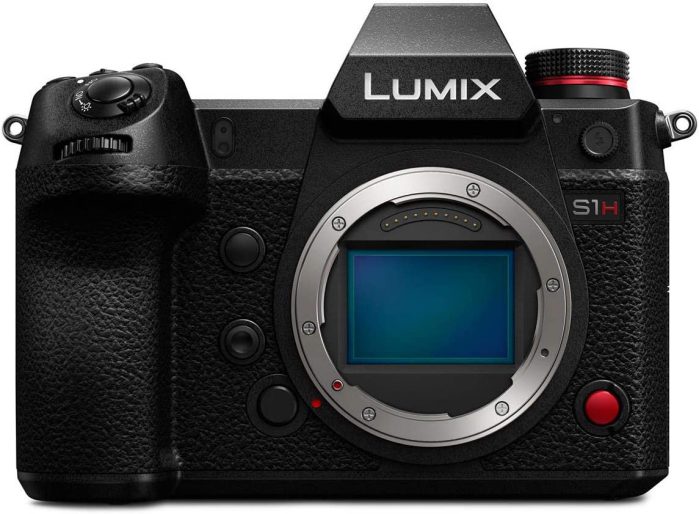
Panasonic Lumix S1H
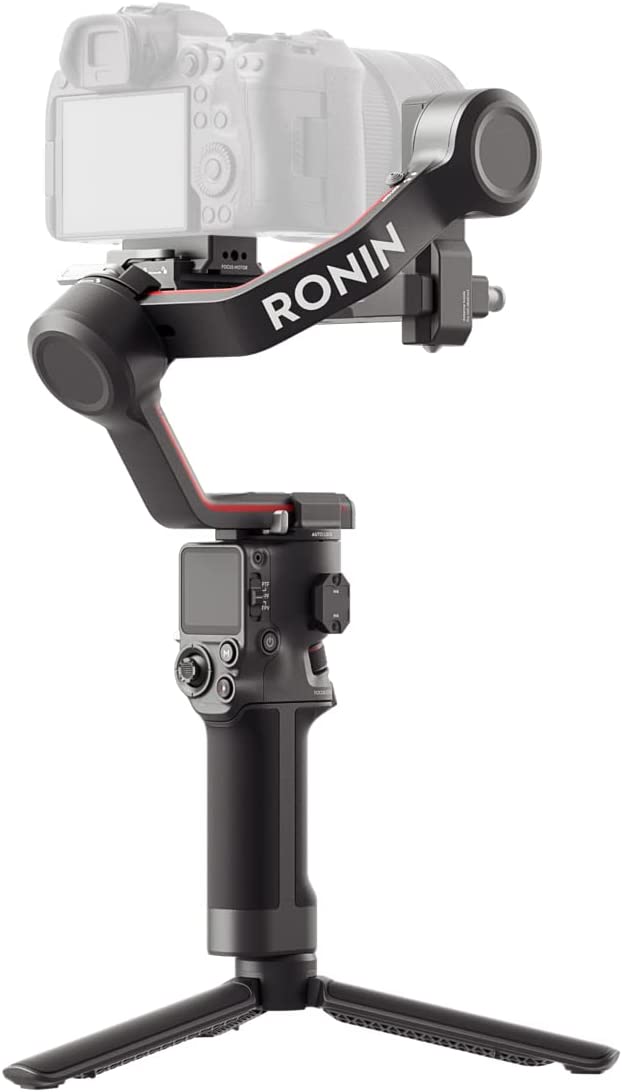
| DJI RS 3 (Best Overall)
|
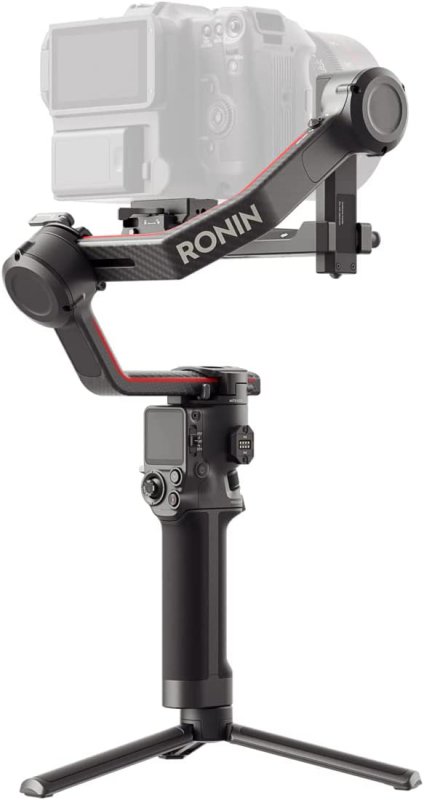
| DJI RS 3 Pro (Most High-end - Highest Payload Capacity & Comes with Advanced Features)
|
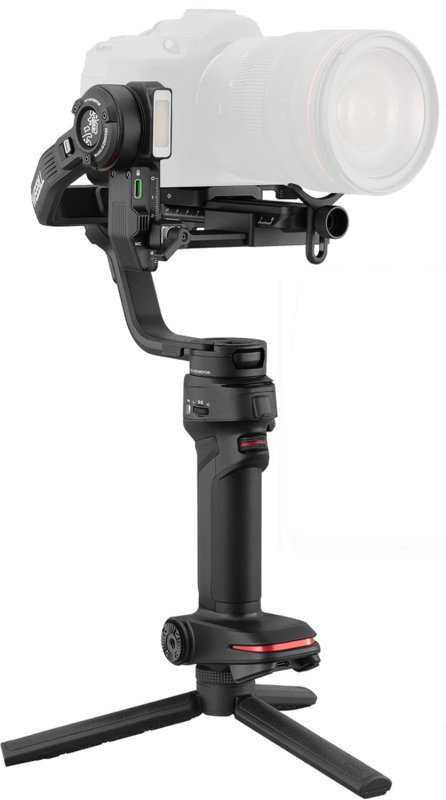
| Zhiyun Weebill 3 (Budget Pick)
|
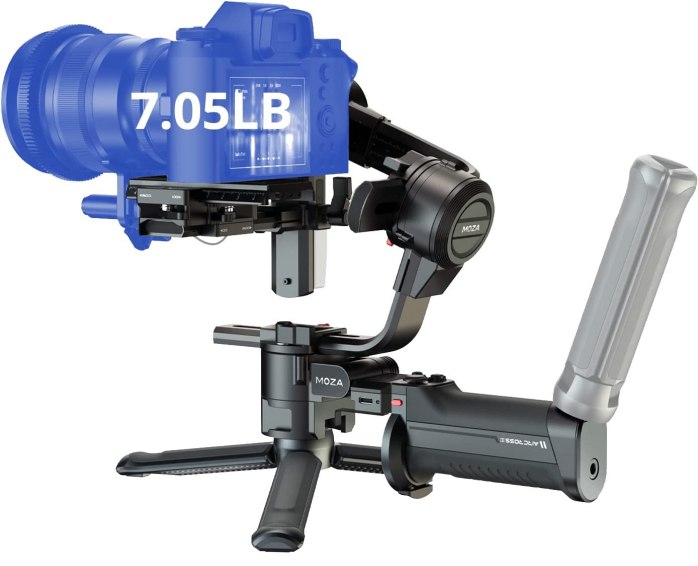
| MOZA AirCross 3
|
So, must I say again, videographers, professional filmmakers, or anyone else who wants to get serious in the photography world and stand out with some flawlessly balanced and sharp shots, this might be the best place you can land on. The little guidance on the gimbal suitable for your Panasonic Lumix S1 H will definitely set your photography skills to the highest level.
So here we go; scroll down and find the four best stabilizers with unbeatable performance and creative verdicts waiting right for you.
Best Gimbal for Panasonic Lumix S1H
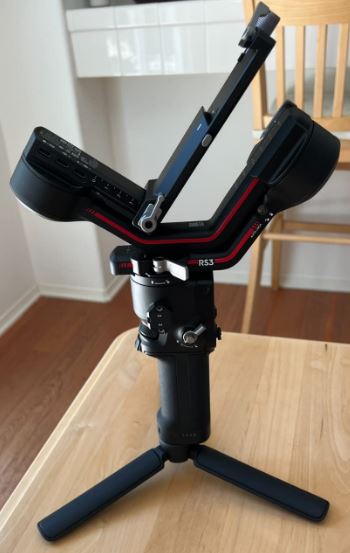
1. DJI RS 3
The trend of capturing something unique and trickiest is increasing these days rapidly; ordinary photography doesn’t stand a chance which is why I turn to rely on professionals.
I brought DJI RS 3 into the game, the gimbal with some fascinating properties, impressive structuring, and wonderful performance. But what makes the gimbal different from others is the easiest way of handling and controlling the same.
As I speak, I don’t require any hard skill or effort to manage the gimbal without the need for professional guidance. Under such a cost-effective range, the gimbal is the best to choose from.
Camera– Panasonic Lumix S1H
Gimbal– DJI RS 3
Why choose DJI RS 3 for Lumix S1H?
DJI RS 3 Is a masterpiece when it comes to its performance; the mirrorless 24 megapixel-ed resolution camera SC-S1H camera can perform a little too well with this all-perfect stabilizer.
The redesigned model of the gimbal with attentive intelligence and the greatest capability to carry and hold extra weights make things interesting enough, but what I love the most is how easiest the gimbal is to hold, and the whole straightforward control panel is the absolute charm for any professional as well as beginners.
Some of the Lumix S1 H can also be accessed with the gimbal itself, so there goes that.
Other than the versatile characters and unbeatable performance, the gimbal does offer tons of creativity being paired with Lumix S1H.
The gimbal design is marvelous; the strongest build, the craziest durability, and much more; however, even with all strength, the gimbal is considered a travel-friendly option because of its least weight, precisely 2.4 pounds.
Nevertheless, the gimbal is considered fast and convenient as well, and there comes the mounting chapter. Situating my Lumix S1H is not much of a hectic task, as the dual-layered quick-release plates help out a lot.
All I did was attach the dual-layered quick-release plates with the camera and slide it into the gimbal. Position around a little to find the perfect balance; once I get that, I immediately lock the position.
Rest after I explore the improved Axis lock and try to exercise by locking and unlocking each axis one by one to secure better balance. Other than that, auto-calibration does the rest of the balancing.
The gimbal is designed with a payload capacity of 6.6 pounds which means Lumix S1H carrying isn’t much of an issue.
The design also has an underrated factor; the gimbal configuration includes a cartridge designed for the battery grip; this makes the swapping of batteries easiest because they don’t interfere with the main operation.
Okay, so gimbals have the primary duty of encouraging stabilization in the footage, which goes pretty smoothly in the RS 3. The gimbal is empowered with an upgraded next-generation stabilization algorithm.
This upgraded algorithm grants 20% enhanced stability over the low-angle shots, or dynamic running scenario shots. Also, the rest is covered with the effective supersmooth mode.
These special modes pour an extra dosage of stability in every shot; this can be achieved because, while in the supersmooth mode, the gimbal increases the motor torque to express balancing.
Not just the stabilization, the DJI RS 3 has the character to perform in every other field, including the different shooting modes.
With the support of Lumix S1H, the gimbal can shoot creative modes like multiple follow modes, intelligent motion function, and rotational. Gimbal Expertise lies in Dolly Zoom, Motion lapse, Track, and Panorama.
Additionally, the gimbal also allows the support of live feed as it supports the Ronin Image transmitter, which certainly can be the RavenEye image transmitter.
This transmitter on the gimbal offers to transmit the 1080p live feed of the Lumix S1H directly to my mobile phone. The tracking also works much better within the transmitter support, if you may ask me.
Apart from that, RS 3 also gets its own vision held up in the upgraded full-color OLED display panel, the full touch control screen with an advanced user interface, and the graphics sidebar.
Also, the OLED gets inspired by the 80% larger display than the previous edition, explained by its 1.8 inches size. This screen also handles precise controls, which are implemented via the wireless and wired modes of handling.
The gimbal has its own set of controls, which is signified by the effortless physical dials on the design. Some attentive ones are the fine-tuning knob that allows the camera to be positioned correctly by assigning appropriate motor stiffness value.
Then there’s the simple slider that offers multiple mode switching and also the front dial. The front dial is interesting as it can be customized with any RS 3 as well as the Lumix S1H setting.
The rest of the stuff is taken care of by the remote controlling, which can be established using the Ronin official application or through the dual-layered Bluetooth connectivity either way.
Talk about the power; with the supportive hand of DJI RS 3, you got the straight 12 hours of filming within a single charge; This is all from the courtesy of a potent lithium-ion Polymer battery used by the brand.
The battery got the power of 3000 mAh to perform shooting all day with extended runtime. And when the battery gets drained off, it would take none less than 2.5 hours to be recharged again and back on track, using a quick charging mechanism.
Sum Up– That’s it; this is how DJI RS 3 Steals the spotlight, which is a fascinating performance rate and no effort required to control the system. This might be an ideal fit for Lumix S1H if you are a beginner or looking for a daily usage gimbal.
What makes it perfect
- Larger 1.8-inch OLED panel
- Upgraded stabilization algorithm
- Improved Quick release plates
- Compact size and least weight
- Additional supersmooth mode
- Decent power support system
- Intelligent function shooting
- Effortless and intuitive control
- Live feed transmitting support
What can be improve
- Durability of the gimbal
- Performance rate with heavy camera
2. DJI RS 3 Pro
Moving on, I got another piece of jewelry from the DJI competent treasury; The upgradation, the advancement, and the high-end performer stepped into the form of this ultimate beast DJI RS 3 Pro.
The highly advanced gimbal is termed as a professional for some serious reason. RS 3 Pro got an unmatchable performance rating, a series of top-notch innovative functions, and an improved design and strongest build body too.
If you are looking for any professional tool to explore deep in the creative world and be a righteous companion to your Lumix S1H., this is the one.
Camera– Panasonic Lumix S1H
Gimbal– DJI RS 3 Pro
Why choose DJI RS 3 Pro for Lumix S1H?
With this very question, the only word that crossed my mind was “Professionalism,” so DJI RS 3 Pro is a big name in the photography world. Lumix S1 H photography can literally use some charm of the RS 3 Pro creativity.
The major reason why it’s suitable for the camera is its highest payload; and the strongest build. If you have interaction with Lumix S1 H, you might have already known that it’s tough enough to be carried with the strongest tool.
Also, the special focusing ability of the gimbal spices things up when paired with the Lumix S1H focusing. Overall, something as professional as RS 3 Pro can transform the ordinary photography skill of Lumix S1H.
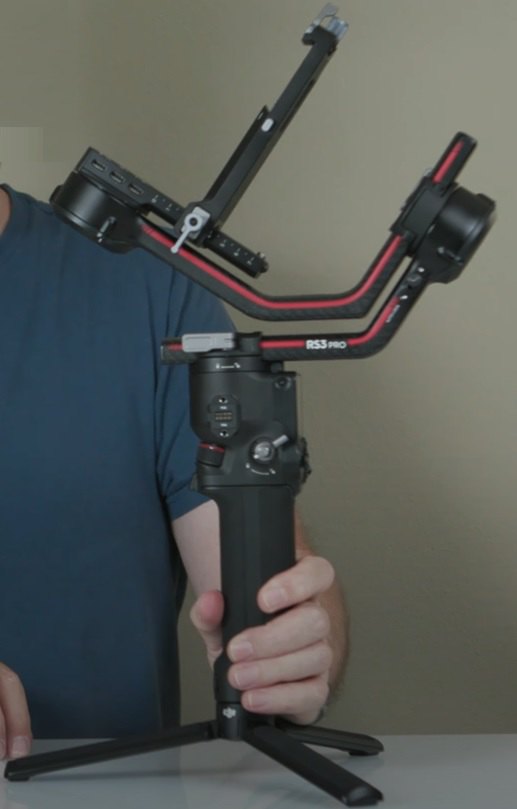
The gimbal is very much considered synonymous with the word Advance; The reforming of the motor potential and other innovations ensure a level-up performance; let’s see how.
Like the name, DJI RS 3 and DJI RS 3 Pro have a few similarities as well as differences in their potential. Of course, RS 3 Pro includes some fascinating, intelligent functions making it special, so let’s start with that.
Even with both gimbal designs very much similar, you can notice some sleeker, stronger, and more rigid factors in the RS 3 Pro body. This is because the industrial-graded material used in the composite of RS 3 pro contains a leveled-up firmness and strength, which eventually leads to better security of its own body as well as gimbals. So the durability level of RS 3 pro is higher than the others.
With the inspiration of more power and smaller size, the RS 3 pro also follows the same stabilization practice, which includes the engagement of a next-generation stabilization algorithm that ensures 20% enhanced stability over dynamic subjects and low-angle shots.
Similarly, like the RS 3, the gimbal also includes the super smooth mode, where the motor of the tool automatically increases the motor torque to announce a more buttery smooth flow in the fast-moving scenario.
However, the upgradation in RS 3 Pro offers the same level of balance with the telephoto lenses too.
The magnificence of greatest stability and higher performance rate works like a pro, but with the involvement of DJI RS SDK, an inbuilt developer protocol that allows the high-end performing feature for an extensive scenario.
Other than that, RS 3 Pro has better involvement with Tracking support; this gets done with the more accurate and responsive Active track pro, which can monitor and keep an eye on the subject and follow the same to where it goes.
The gimbal also supports the usage of a High-Bright Remote monitor that can be used with the Ronin 4D hand grips, DJI master wheels, or so; I prefer DJI Force pro; this gives another level of controlling the gimbal.
Also, this whole support has the intention to achieve faster camera movement from any vehicle or jib. All left is the effortless engagement of the control panel.
The gimbal follows the same wired and wireless controlling system where the gimbal, as well as the mounted camera Lumix S1 H basic setting parameters, can be viewed and controlled through any smartphone using Ronin’s official application.
While some of the basic dials are carved out on the gimbal body to carry on the straight task while you are filming, these dials might include the fine-tuning knob, the magic worker that sets the camera position by deciding motor stiffness value.
There is a slider for the shooting mode switch and the front dial for the zoom and focus. Also, there is a Teflon-coated component that works to reduce the lower friction resistance to pour more smoothly.
With the display aspect, the gimbal follows up the same 1.8-inch large OLED display with precise control and a better user interface.
RS 3 Pro ultimately has a scaled-above performance, if you may ask; so does its versatility factor. Among its other creative features, let’s take the LiDAR focusing technology, for example.
The Auto and manual focusing of Lumix S1H get the upper hand expertise of Ronin 4D’s focusing technology, where the latest and upgraded LiDAR Range finder projects 43200 ranging points within a certain distance to focus on the subject; the LiDAR focusing turns out to be pretty effective for the fast-moving subject.
As easiest as pie is the mounting of the camera on RS 3 Pro, the quick-release mechanism strikes in the action where they put their dual-layered quick-release plates to be attached with the camera and slide lock inside the gimbal body.
Improved Automated Axis lock allows you to explore the right balance while mounting the camera, and you can lock each axis to expand the creative horizon of the camera while filming different angles.
The gimbal got the strongest body to secure the mounting and steady your camera safely when calibrated.
And when it comes to accessories, the DJI RS 3 pro certainly eliminates all the constraints of carrying accessories. The 10 pounds of payload made enough space, while the gimbal is configured with multiple ports for accessories, including the Dual RSA with NATO Port for collaborating with Twist grip handles or other tools.
I personally added a tethered control handle to make my filming go smoother. The gimbal configuration is a bit different from the previous RS 3; the strongest composite is used to fulfill the void of less durability, while the Carbon fiber constructed axis or arm of the gimbal is known to have the greatest flexibility, strength as well as lightest weight.
The 3 pounds overall weight of the gimbal is not too high or not too low to carry the camera around; the stiffness alone is definitely a plus point in the safety aspect.
The power support system of DJI RS 3 Pro is much similar to the DJI RS 3; the gimbal is all covered with the super potent Lithium-ion polymer battery in its cartridge-designed body.
The battery is empowered with 1950 mAh, which slightly differs from RS 3. The battery grants the same 12 hours of longest working hours within a single charge. But things get better when it comes to the recharging of batteries.
Since the gimbal has the cartridge designing battery grip, there isn’t any hassle to charge the batteries separately, and supporting the 18-watt PD fast charging, the gimbal takes only 1.5 hours to be recharged again.
Sum Up- There is nothing more amusing than the smartest tool doing the cinematic shooting job for you; RS 3 Pro is definitely “The One” that can bring promising change in your photography skill. The price might be a little high, but Consuming top-notch functions and intelligent character makes it worth it…
What makes it perfect
- Rarest yet effective LiDAR focusing
- Highest payload
- Carbon fiber gimbal’s arm
- Improved Active Track pro
- Super Smooth Mode enabled
- Extensive coverage for performance
- Additional port for accessories
- Quickest charging and power
- Upgraded stabilization and controlling
- Highest payload above all
What can be improve
- Little difficult to operate
- Doesn’t come pocket-friendly
3. Zhiyun Weebill 3
Zhiyun is known for its innovation; they are the leader in the action cameras and accessories manufacturer world because it indulged in featuring smart algorithms and motors.
That’s what they did with the Weebill 3. Now the most iconic Weebill 3 gimbal is tycoon before of its smoothest balancing. The more functioning way to say this is the Zhiyun Weebill 3 gimbal is best for Lumix S1H as it provides an easy and smooth way to frame some wonderfully flawless photos and videos without having to use any additional pricey stabilizer.
So there goes that, but to rest assured, let’s have a nice and deep look over its major characters.
Camera– Panasonic Lumix S1H
Gimbal– Zhiyun Weebill 3
Why choose Zhiyun Weebill 3 for Lumix S1H?
I Prefer Weebill 3, a unique piece of companion for the Lumix S1H, because of the gimbal design itself; now everyone knows how creatively the body of Weebill 3 is designed, but the ergonomic I felt using it with Lumix S1H is absolutely stunning.
Except that, the gimbal has a wonderful stabilization algorithm which is a charm for the Lumix S1 H in-built stabilization. The Weebill 3 got a unique ability to frame quality in the dark, this is super beneficial for the Lumix S1H auto ISO and some extra hours can help the guy out to tape longer than ordinary.
So yeah, the battery is also a great factor. There are other features that made me choose this one for Lumix S1 H.
Talk about the innovation, and here I go wandering around this magnificent piece of the tool; Rich in the artistic verdict, Weebill 3 is known for its incredibly structured body.
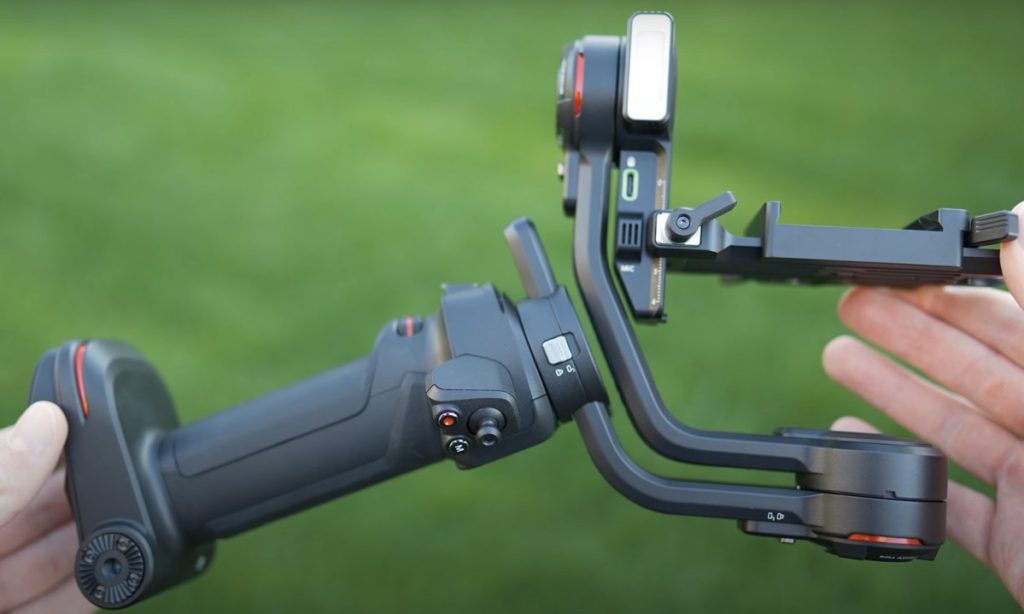
The improvement in the inner mechanism, design, and stabilization can be displayed quite perfectly within this updated Weebill 3, but let me tell the success story of this three-axis gimbal to start with its heavy amount of ergonomics, which comes from a peculiar design.
My Lumix S1 H has a great time with the weebill 3 because the L-shaped body of the gimbal is strong enough to stand on a flat surface on its own, meaning no more hassle at buying a tripod or something.
Also, the gimbal is engineered with the sling 2.0 structure with some greatest improvements, and then the durability is highly supportive because this way, I can bring my dearest gimbal to any harsh climate, or I didn’t find much trouble catching tight space shots either.
But that’s not just it; what’s more amusing is that the gimbal is rich in ergonomics because I surely don’t feel much strain on my hand during my time with Weebill 3. This is so because it has a supportive wrist rest that allows you to rest your hand in the middle of longer filmmaking stuff.
And there is also an extendable sling grip set that allows you to catch the higher-angled shot or the lower one without having to extend your arm longest.
That comes within the travel-friendly aspect, so is its compact body and optimized configuration. And the topping of the lightest weight, precisely or 2.4, is icing on the cake.
The mounting of the camera goes on the same road of comfortability; Weebill 3 uses Dual quick-release plates to be attached and mount the Lumix S1 H cautiously with the gimbal. The upgradation in the quick-release plates avoids any need for rebalancing in the future.
And the whole mounting gets better with the additional support of a magnetic wrench embedded in the design that secures the camera in the body and is found helpful in carrying other accessories.
There is no full disclosure of the maximum payload ability of the gimbal, but speaking of my experience, the 2.56-pound Lumix S1H with a mid-ranged standard lens and other accessories goes on pretty smoothly with the Weebill 3.
So, it’s not entirely wrong to say the gimbal can carry up to approx. Six pounds of weight within its potentiality. When it comes to the Weebill 3 primary duties, do you think Zhiyun will ever let you go off disappointed?
The smartest stabilizer uses a compact and more powered motor, which exposes an out-of-the-world optimized stabilization algorithm for every trickiest or speedy subject shot.
Apart from the stabilization obligations, the gimbal plays its part in allowing the Lumix S1 H to explore the world of creativity; yes, it allows filming the trickiest angle and tight spaces in the most amusing way possible.
The gimbal allows the S1 H to shoot 360-degree rotational, multiple-follow, and intelligent motion functions like time-lapse, panorama, and track shooting.
Switching to these modes can be effortlessly controlled via the straightforward trigger buttons that are carved on the design and that can be customized accordingly.
Also, the gimbal comes with in-built fill lights making it magical for dark-hour filming and stuff; the in-built fill lights do have 1000 lumens of brightness and different color temperature.
The brightness and color temperature can be adjusted according to the requirement of illumination in the footage signifying a charm to the Auto ISO of Lumix S1 H. Moreover, these fill lights also include four colored filters, one that can be switched to cause dramatic effects in the frame.
Other than that, the design of the gimbal has a rigid spot of an in-built microphone within a 3.5mm general audio port; this mic is really helpful for managing vlogging, cinematic, commercial, or travelogs, stuff dealing the noise canceling, Hi-Fi, and cardioid recording.
Speaking of which, there is also a wheel control I found fascinatingly enough; this wheel allows access to the gimbal movement, focus, and zoom settings parameters as well as the Lumix S1H basic settings, which can be customized according to self-usage.
This was the physical controlling system; the gimbal also supports the wireless or remote control that can be implemented with the support of the Zhiyun official application.
There isn’t much trouble connecting your gimbal to any other devices; the wireless 2.4 GHz Wi-Fi and Bluetooth 5.0 technology can do the hassle-free connectivity management job pretty wisely.
Among other innovations, Weebill 3 also got this solid, highly responsive 0.96-inch OLED panel with an upgraded user interface and intuitive control support.
And then there is the wonderful power backup; Three enormously potent Lithium-ion Batteries that have the power of 2600 mAh, enough to approach 21 hours of straight runtime when it’s charged fully.
With the significance of the quickest charging mechanism, the gimbal takes none less than 2 hours to be recharged quickly, which is almost the God for my Lumix S1 H performance.
Sum Up– Weebill 3 is one of the most highly respected gimbals in the world because it got the most attractive design. Not just the stabilization algorithm, the buttery smooth control, and high-end intelligence, it’s like a party every day, so under that affordable budget, it might be the best of all.
What makes it perfect
- In-built Fill-up lights
- Improved sling 2.0 structure
- Lightest weight and compact body
- Longest battery runtime of 21 hours
- Support in-built microphone
- Optimized stabilization algorithm
- Easy and convenient quick release
- Effortless controlling system
- Super lightweight body
- Additional Wrist resting support
- Better dark-hour filming expertise
What can be improve
- Needed disclosure on payload
- The display panel is the smallest
4. MOZA AirCross 3
The next gimbal on the list is from another wonderful brand Moza, Another iconic brand of the photography world that gained much popularity over its outstanding services and smartest tools.
What I like the most about this brand is they guarantee the ethical stabilizing tool, and they take care of the convenience of the photography, which is why I am listing one last gimbal for Lumix S1H.
A masterpiece with a ton of responsive functions and an industrial-graded stabilization algorithm. Plus, a wide space for comfort and ergonomics, so what’s to say? Let’s decide after looking at its significant character.
Camera– Panasonic Lumix S1H
Gimbal– MOZA AirCross 3
Why choose Moza Aircross 3 for Lumix S1H?
One of the major reasons for picking the Aircross 3 for Lumix S1H is its super compact design; I mean, literally, who would not want to carry a gimbal that can fit in the smallest backpack?
Also, even with the smallest design and cost-effective creative, it’s quite amusing how the Aircross 3 got so much intelligence which is something a high-profile camera like Lumix S1H can use.
The decent payload of the gimbal clears the path for any additional accessories, and the improved stabilization carries over the trickiest shot like tacky angle, tight space, or creative motion functions and all.
So yeah, the Aircross high-end advancement conveniently suits the Lumix S1H.
Aircross 3 is definitely the sum up of performance, convenience, and budget, which makes it super interesting. It’s one of the finest creations of Moza that empowers to steal the spotlights with its intelligence.
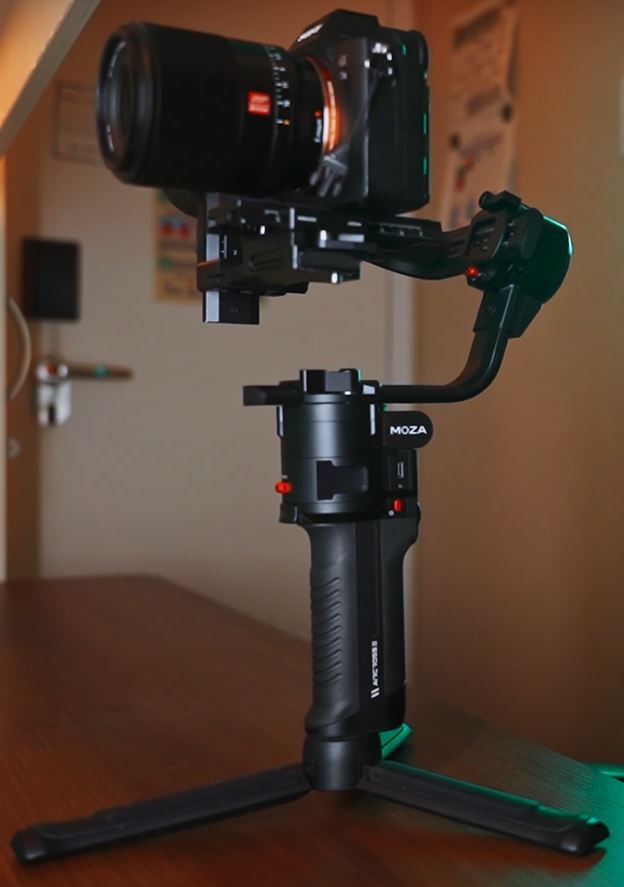
Famed for a lot of things, but the Moza Aircross does come with an astonishingly impressive compact design and an attractive-looking modular body.
The ergonomic level is much higher than the predecessor, and the gimbal fancies are never seen and experience durability. The durability comes from the strength of the gimbal, and the strength comes from the high-leveled metal construction.
And above that, the gimbal stick with the least weight, 2.9 pounds.
The compact design gets more interesting with its foldable structuring approach; this encourages the gimbal to be folded down to the size of A4 sheet paper, enough for easy storage and transport.
This will eliminate any slight chances of strain on the hand. Aircross 3 comes with the potentiality of carrying 7 pounds of weight load, which specifically means the camera is strong enough to carry most of the accessories as it requires to frame exceptions.
But that’s not just it; I literally have been crushing over the gimbal super potent motor, if you may ask.
The motor inspired by a less power-consuming and more efficient provider theme has got everything under control, its works for indulging high-level stabilization in every shot and butter-smooth finishing.
Backing up the competency of the motor, the gimbal uses the deep red algorithm, one that plays a significant part in making the gimbal better at control, behavior prediction, and other management. The supremacy of this algorithm can be expressed with the higher level of stability present in the frame.
Other than that, the motor is pretty dedicated to exploring creativity by tapping into different shooting modes; the rotation 3D, intelligent motor function like time-lapse and panorama is great enough.
But the Aircross 3 showcases its skill in four follow modes, including the pan follow, pan-tilt follow, FPV, and Sport modes. All of the modes are bent on granting flawless pictures with the dreamy artistic vibes possible.
However, there is something unique about Sport mode 2.0 because it’s not ordinary like others. While using it with Lumix S1 H, you will see the mode features all lock follows with the five adjustable speed control making live action to be caught smoothly on camera.
The rest of the controls are easiest as pie in the gimbal, like the single tap from switching portrait to landscape mode, A dial for the auto-tuning function, a button for photo shutter or recording, or a simple touch to the guaranteed impressive inception mode and so on.
And if you are not okay with the physical engagement, you can also go knocking on the door of the remote control, which can be established using the official Moza Application.
As per the display, the Aircross 3 upgradation allows the configuring of an updated OLED panel with a User interface like never seen and the graphic sidebar menu to keep pace with both Gimbal and Lumix S1H.
The simplest configuration of the gimbal uses quick-release plates for attaching the camera to the gimbal backed up with a manual axis lock. The three-latch locking system allows one to get the vision of own balance and lock the axis whenever required.
Two of the shoe mounts lie around for the dominant accessories like the artificial lights or microphone, While the three mounting threads, in addition, play their part in allowing for mounting other extensions, tripods, rigs, and other accessories as well.
And then there is Manual position 2.0; this is a special feature that allows the gimbal to manually pull and drag the camera to turn the shooting position and keep staying on, which is like the piece of cake for follow modes and dynamic filming.
The gimbal angled arm or axis, whatsoever you say, is designed in such a way that grants a clear view of the camera display without blocking while rotating through a different angle.
With the competent hand of the strongest Lithium-ion battery charged to 3500 mAh, the Aircross 3 exposed the longer 19 hours of constant working on a single charge.
Then again, the Aircross showcases its peculiar innovation with the smartest vision of quick charging and not just ordinary one; It uses two USB Type C ports to charge the gimbal battery in less than 1.4 hours only, ideally for professional means.
Also, the gimbal can be used as a power bank to grant power to Lumix S1H, which is the silver lining for my 3050 mAh powered Lumix S1H.
Sum Up– There is so much to list when it comes to Aircross 3; it’s an upgraded model of Moza that is filled with almost every enhancement that works for filming higher-quality images. However, there is a more game-changing function that can literally decide the fate of your filming skill.
What makes it perfect
- Spark supply system 3.0
- Manual position 2.0
- Decent payload and the least weight
- Sport mode 2.0 with adjustable speed
- Three-latch locking safety
- Auto calibration and Deep red algorithm
- Compact body and foldable design
- Budget-friendly Approach
- Quickest charging with two USB
- Additional mounting thread
What can be improve
- A little too much manual
What are the steps for buying the right gimbal?
As you have already concluded, Gimbals are one of the wisest tools used in filmmaking that guarantees quality footage by approaching the infinite level of stability and cinematic effect in the dynamic subject shot.
This makes the gimbal not only a great tool but also something big that is responsible for bringing transformative enhancement to your skill. Thus, purchasing the right one became quite a challenging task.
The assurity of the right products for our needs and the effective result we desire makes the purchase worth it, so there are some significant steps that will give you an insight into how to buy an ideal gimbal for your Lumix S1 H or any other camera.
There are a number of things; you need to consider before buying the right gimbal; you will probably need some research and planning if you want to put your money in the right place. So, let’s discuss them.
Step 1 - Pre–Process:
The pre-process usually means the planning and research which you should be doing before wandering out in the market for the stabilizer. So, this pre-procedure includes a few small tasks.
Need and standard– First thing first, you need to ensure what exactly you are looking for. Narrow down your area of usage and note the things you want your gimbal to do. For instance, if you want a professional, you will be looking for a powerful motorized gimbal. So, make a mental note of what your requirements are.
Research– Once you know what you want, research the brand and products a bit. Check out other photographers’ preferences, expert reviews, and other guides. Also, choose the right store, either a digital or local store.
Budget– The most crucial step, make sure you set a decent price budget before leaving for the purchase. You have to set bars on enough money to buy the tool that you originally needed. Do not be amused with expensive products; make sure you are getting the right gimbal.
Step 2- Main Doing
After the whole planning and research stuff, the real action began. Once you know what you are looking for, finding the best products for your needs becomes easier. There are a few characters of the gimbal that need to be cross-checked before any final decision.
Camera compatibility- While you are looking for the gimbal, make sure whichever one you are choosing is compatible with your camera or not. Go through the gimbal specification and determine whether it supports mounting with your camera or not, with Lumix S1 H in this case.
Payload– The potentiality of the gimbal can be defined by the maximum payload it handles. Try to pick the gimbal with the highest payload because that will allow the maximum number of accessories to be paired with and even support the larger and little bulkier size cameras.
Mounting– Gimbal is known for convenience, so make sure you don’t have to invest a lot of effort in the whole mounting stuff. Check out the secure and easiest mounting like the modern gimbal’s Quick release system, and attempt to save time and energy.
Performance– Considering the duties of stability, you need to be sure of the gimbal’s method of stabilization and look after the motor. This will allow us to get an insight into the level and quality of stabilization provided by the gimbal.
Versatility– Along with the quality stabilization, don’t forget to check on the versatility meaning the different things the gimbal can do. This will include tracking subject support; transmitter lives feeding support, and other innovations.
Creativity– Next comes the creative aspect; remember not just stabilization, the gimbal needs to secure creativity as well. So ensure that your to-be gimbal supports different shooting modes, including multiple follow, intelligence motion function (Time-lapse, panorama), 3D rotation, Live action sports, and other shooting modes.
Ergonomic-As much of the creativity, the gimbal needs to be ergonomic and comfortable, which is why to make sure you cross your eyes with the gimbal ergonomic, like the additional wrist rest support, sling body, or extendable handle kind of stuff.
Durability– For the sake of the gimbal security, you need to make sure the gimbal you are choosing is strong and durable enough to carry not only the camera but also other accessories. So look after the composite material, its strength, and its durability level for the safety of your gadget.
Maneuverability– When it comes to longest hour filming or travel videos shot, you cannot afford to have a large and bulkier sized gimbal, so make sure your camera sticks with the compact size and least weight so that it can be transported and stored easily
Control– Creativity can now be easier if you know how to handle the gimbal. So do not entertain the lengthy and complicated configuration; make sure you are getting a straightforward control panel and a user-friendly approach to usage.
Brand– Another crucial factor is the brand; you need to look after one well-reputed and popularly reliable brand to trust with something as important as a gimbal. Research the gimbal’s brand a little by reading ratings, reviews, and other market value.
Step 3 - Post Process:
Now that you have brought your gimbal you should really get into the business of professional filming. However, there are a few post procedures you can do to cross-check your purchase.
Test– Once you get what you need, make no delay in testing out the whole system working. Attach your gimbal with the camera and check whether it’s working well. The balance, the design, and the function all blend in, perfect or not.
Accessorizing– Gimbal itself is the perfect tool to change the game in filmmaking; however, if you need enhancement in efficiency, consider buying a few accessories for your brand-new gimbal. Accessories like a counterweight, dual handle rig, transmitter
Maintenance– With so much effort into buying the right gimbal, you certainly don’t want to get it all in vain. This is why I recommend being extra cautious with the usage and care of the gimbal and taking a few moments to spend on the Gimbal’s maintenance.
Panasonic Greatest Jewel: Panasonic Lumix S1H
Out of the competent hand of the iconic Panasonic treasury, this advanced full-frame mirrorless camera came out offering high-end features and a great taste of professionalism on board.
Panasonic has been slaying the market with their wonderfully cooked-up tools, and they can launch this Lumix S1H as another precious addition to their exquisite diaries.
Characterized for its impressively potent processor, powerful internals, and its notable character, the Lumix S1 H has been ruling millions of hearts with its fruitful performance rate.
The brand has introduced this masterpiece, and Netflix approved recently in October 2022
Even though the Lumix S1 H has been blessed with incredibly better focusing, Supreme low light filming ability, perfect white balancing, stabilization, and speed, all eyes go on the impressive video capabilities.
And then again, let’s not forget the strongest build and durable body of the camera. Consuming versatile performance and function, the price tag sticks to the most affordable borderline of $3999 only for the body.
Pros of Panasonic Lumix S1 H
- Magnificently impressive video ability
- Wonderful ISO range
- In-built cooling support
- Excellent display
- Durable body and physics
- In-built 5-axis stabilization
Cons of Panasonic Lumix S1 H
- Large body and bulkier
- Expensive a little
- Autofocus needs improvement
What is the primary expertise of Panasonic Lumix S1 H?
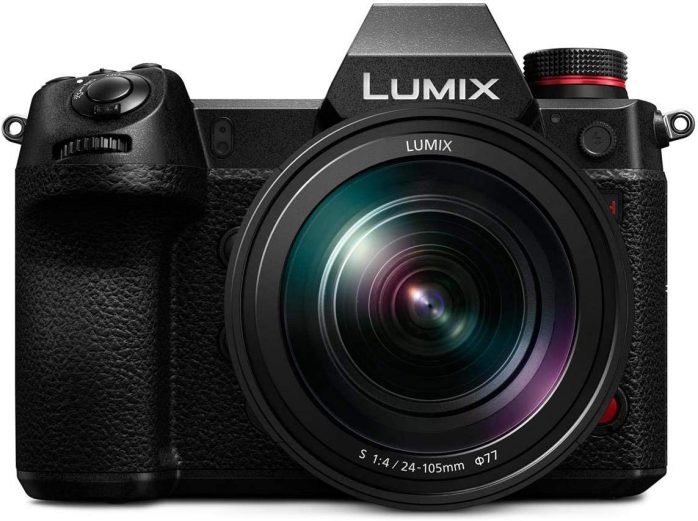
The Lumix S1 H is quite the charm with its own mouth-watering video potentiality and high-end function; some of the primary expertise that makes it special is
The Lumix S1 H camera doesn’t have the full-frame CMOS sensor that processes the 24-megapixel resolution, carrying out the legacy of filming still images.
The same upgrade approaches the performance; the camera doesn’t have the Venus Engine processor that manages the highest performance rate.
Being a video-centric camera, It has the potential to shoot up to 6K videos at up to 24p speed; then the Ultra HD 4K at the speed of 60p and the full HD at 120p.
The camera is an expert at focusing and processing both Auto and manual focusing with the continuous, single servo mode and 225 autofocus contrast detection points.
The camera has wonderful expertise in filming dark hours due to the effective Auto ISO support. The camera’s ISO sensitivity ranges from ISO 100 to ISO 51200 which can be extendable to ISO 204800.
The camera also has wonderful exposure modes, including the aperture priority, manual program, and shutter priority mode; riding the exposure compensation of -5 to +5 EV; Also, it has a 2500 to 10000K white balance range.
The camera has an excellent display with the In-built electronic OLED viewfinder; The panel comes with 5.76 million dot resolution and 100% coverage along the 0.78x magnification.
Also, the camera gets the assistance of a free-angle tilting LCD screen with fingertip touch control. The screen that sized wide at 3.2 inches and with the 2330K dot resolution
The camera is associated with an electronic and mechanical focal plane shutter with a speed of 1/8000 to 60 seconds speed. The same shutter allows continuous shooting at the nine frames per second speed.
The camera is majorly video-centric, which is why it holds the in-built Five-axis image stabilization that works with the five stops to compensate for the camera’s micromovement damaging imagery.
The camera supports the dual slot for memory card requiring the SDHC or SDXC memory card in the UHS-II bus format. Also, there is the HDMI, 3.5mm headphones and mic, and other USB-C interfaces.
The camera gets the assistance of a powerful lithium-ion battery charged to 3050 mAh, empowered enough to grant the constant 400 shots within a single charge. The battery can be recharged using a quick charge mechanism.
Subjecting to the body, the Camera is designed within the SLR-style mirrorless structure with the strongest composite of Magnesium Alloy for high durability and strength.
Also, the Camera body is environmentally sealed and protected with water resistance with high ergonomics and at least a 2.32-pound weight for the body and includes batteries managing portability.
Frequently Asked Questions (FAQs)
Q. What will a gimbal bring to my Lumix S1 H?
With Panasonic’s immense ability to shoot 24 megapixels, the gimbal might be the only key factor that allows it to utilize its power to its full extent. With the resolution, you can now get professionalism in the shot because of the exposed stability in the frame. But that’s not just it; gimbals are considerably the best accessories to use because they will expand the Lumix S1 H creative horizon.
It can bring the artistic aspect by evolving filming in multiple follow modes, engaging with the time and action and shooting some intelligent motion function modes, and much more. Also, gimbals can bring tons of comfort, if you may ask, by carrying a 2.56-pound Lumix S1H in hand; thus, gimbals can literally give a lot to Lumix S1 H.
Q. Is the Panasonic Lumix S1 H a good camera to start with?
Of course, it is; the Panasonic Lumix S1 H is a high-end innovative full-frame mirrorless camera that comes with astonishingly pleasing impressive video capabilities. Due to the simplest configuration and user-friendly interface, the camera is considered a beginner-friendly camera.
The camera has a 24-megapixel resolution and 6K video potential, but all of its internal shooting mechanisms are configured pretty straightforwardly. The focus, ISO, and white balance management doesn’t require special skills. And the ergonomic and compact body of Lumix S1 H satisfies the criteria of making it convenient to enthusiast photographers; the least 2.56-pound weight on top of everything keeps things simplest, which is a big plus for beginners, so yeah, it is a good camera to start with
Q. Does the gimbal need any accessories of its own?
Gimbal itself is known for its smartness and its potential to provide comfort, but yes, it can use the association of some accessories to enhance the efficiency of its performance. Such as the dual handle rig, it’s a tool to use a gimbal with both hands. Counterweight to equally distribute the weight of mounted objects and balance.
A focus motor for better focus control and zoom. An extra pair of batteries to avoid sudden power interruption or to save time idly during battery charging. Also, it’s almost essential to accessorize the gimbal with the right transmitter for the live feeding of camera vision; this makes filming so much better.
Q. Where can I buy an inexpensive gimbal for the Sony A7 in 2022?
Usually, the gimbal doesn’t stick with a higher price range; they are constructed to be used as an affordable option for beginners and professionals, at least more affordable than the stabilizer and tripod. The gimbal can be bought from either an online digital store or from the local market; the price usually doesn’t differ a lot.
However, generally, the physical stores stick to the original price tag whilst some of the online stores, like Amazon, offer deals and discounts on the product. So, which one seems to be wise enough for you? There is, though, the risk of authenticity in digital stores purchase which is something that can be avoided by going to a local store, trying the product first, and then paying off. So, your choice.
Wrapping Up
So, that was the wrap-up, all the essential details, and the perfect four gimbal options to enhance the charismatic performance of your Lumix S1 H. In doing so, it’s probably best to invest in a camera that you actually need.
So even with all the recommendations, before buying the new gimbal, try to research a little bit on your requirement, standard, and needs; only this can ensure you’re a worthy purchase.
If you ask for my personal opinion, I am going to go with the Moza Aircross 3 gimbal as the finest edition for the Lumix S1 H because of its heavy load of versatility, comfortability, and performance.
The gimbal has a decent 7-pound payload, 19-hour power, and an affordable price tag, and is suitable for Lumix S1H working. However, all the other three are no less, so choose wisely.
So that was it; that is how I am going to leave my goodbye with the possible enough details that will help you find your ideal gimbal stabilizer for Panasonic Lumix S1 H If you might not have already met one.
If you have confronted the one and only gimbal that will be riding by your Lumix S1 H side, do not forget to let me know in the comment section below. And for some reason, you haven’t gone exploring the world but keeping the mental note on the whole buying guide stuff.
Now with the whole establishment, it’s time to bid my adieu until the next time.